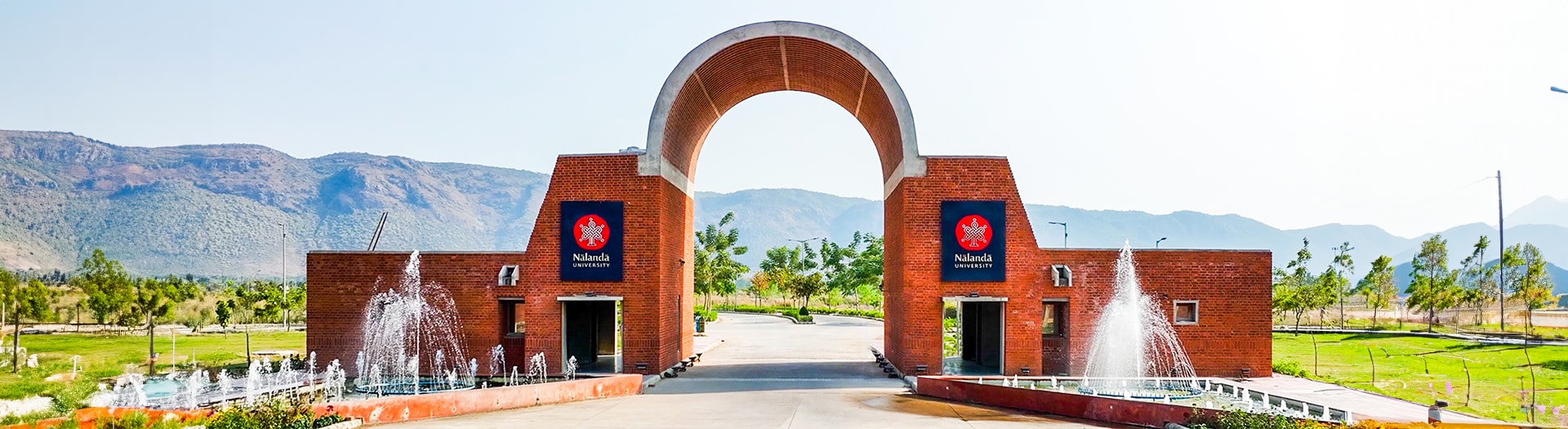
M.A. /M.Sc. in Mathematics
The Mathematics Department at Nalanda University offers a well-structured program that builds a strong foundation in both pure and applied mathematics. It covers important areas such as differential equations, algebra, analysis, geometry, and mathematical modelling while developing student’s analytical and problem-solving skills. The department also promotes interdisciplinary learning by connecting mathematics with fields like physics, computer science, and economics, and encourages research-oriented study. Overall, it aims to prepare students for higher studies, research, and various professional careers.
State-of-the-art Laboratory
The Mathematics Laboratory at Nalanda University provides a state-of-the-art environment that supports both theoretical understanding and practical application of mathematical concepts. Equipped with modern computational tools, advanced mathematical software, and interactive learning resources, the laboratory enables students to explore areas such as numerical methods, differential equations, and mathematical modelling in a visual and applied manner. It fosters analytical thinking, problem-solving skills, and innovation through hands-on learning and research-oriented activities, while also encouraging inter-disciplinary collaboration with fields like physics, computer science, and environmental studies, thereby preparing students for academic research and professional careers in science and technology.
Distinguished Visiting Faculty and Faculty Members
- Prof. Animesh Biswas (Professor University of Kalyani)
- Prof. Dibakar Ghosh ( Professor ISI Calcutta)
- Prof. Krishna Kumar (Professor IIT Kharagpur)
- Dr. Ashish Awasthi (Associate Professor NIT Calicut)
- Prof. Jayanta Kumar Bhattacharya (Retired Director HRI Allahabad)
- Dr. Rajeshwar Mukherjee, Assistant Professor and Interdisciplinary Faculty
- Dr. Vikash Vimal (Guest Faculty)
Special Area of Research
- Numerical Methods for Nonlinear PDEs
- Stability and Convergence Analysis of Numerical Schemes for Nonlinear PDEs
- Reaction–Diffusion Modelling
- Computational Fluid Dynamics
- Dynamical Systems and Chaos
- Mathematical Modelling of Brain Response and Neuronal Dynamics
SEMESTER WISE COURSES
| LIST OF COURSES | ||
|---|---|---|
| SEMESTER | CORE COURSES (3 CRED- ITS EACH) | ELECTIVES IN CAFETE- RIA MODEL (3 CREDITS EACH) |
| SEMESTER 1 |
|
|
| SEMESTER 2 |
|
|
| SEMESTER 3 |
|
|
| SEMESTER 4 |
|
|