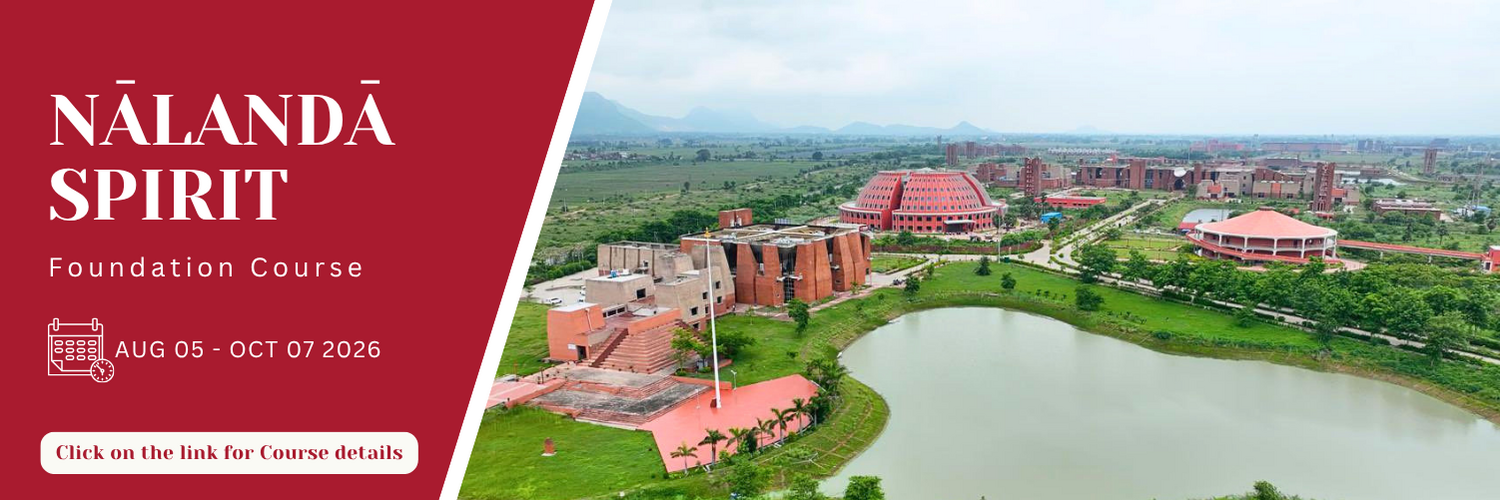
The Nalanda Spirit
Concept Note
Designed for students from diverse international and cultural backgrounds, this course introduces the intellectual and institutional legacy of ancient Nālandā through a critical engagement with its historical evidence. Rather than treating Nālandā merely as a nostalgic memory of the past, the course approaches it as a historical institution and as a significant expression of the intellectual, philosophical, cultural, and civilisational ethos of Indian knowledge traditions. More importantly, the course aims at recontexualizing this legacy in our contemporary situation.
The course creates an interdisciplinary space in which students from diverse academic disciplines engage with major strands of Indian thought, their historical development, wider intellectual and international connections, and contemporary relevance. Its scope therefore extends beyond the historical study of ancient Nālandā to an examination of the intellectual values, methods, and traditions associated with it and their relevance to the present.
The curriculum is organised around four principal objectives:
Objective I: To critically examine archaeological and textual evidence relating to Nālandā, distinguishing historically substantiated evidence from later tradition, legend, and hagiography.
Objective II: To examine the classical Nālandā curriculum, including the pañca-vidyā and sixty-four kalās, as an integrated framework of human formation, and to situate it within the wider network of Indian and transregional centres of learning.
Objective III: To revive śāstrārtha as a method of intellectual training, requiring students to present the pūrvapakṣa in its strongest form, formulate and defend their own siddhānta, and engage rigorously with critical questioning.
Objective IV: To relate selected intellectual, ethical, economic, and artistic dimensions of Nālandā to contemporary questions, developing students’ capacity for reasoned written argument and oral defence.
Agenda
| Date | Title and scope | Faculty / Resource person |
|---|---|---|
| 5 Aug Wed |
Nālandā: Wisdom, Heritage and the Idea of a Living University Course orientation — learning outcomes, the reflective journal, and the continuous-assessment scheme explained in full. |
Hon’ble Vice Chancellor |
| 12 Aug Wed |
The Origin, Foundation and Chronology of Nālandā Mahāvihāra Foundation legends against established evidence; the Gupta-to-Pāla sequence; what can and cannot be fixed in time. |
Prof. K. T. S. Sarao |
| 17 Aug Mon |
Testimony of the Travellers: Faxian, Xuanzang, Yijing, Hyecho and Dhyānabhadra What each observer saw, when, and for what audience they wrote; the limits of pilgrim testimony as historical evidence. |
Prof. K. T. S. Sarao |
| 19 Aug Wed |
Pratītyasamutpāda as Ecological Reasoning: Interdependence, Sustainability and Voluntary Simplicity The vinaya regime, the tank-and-field economy of the Mahāvihāra, and the ethic of restraint read from the sources. |
Prof. K. T. S. Sarao |
| 24 Aug Mon |
Nālandā and Its Extension: Vikramaśilā, Odantapurī and Valabhī, and the Older Centres of Learning | Dr Pranshu Samdarshi |
| 31 Aug Mon |
Knowledge Heritage of Nālandā: Nālandā Masters, their Teachings and Contemporary Science Nālandā ācāryas and transmission by lineage; commentary and contemporary reflections. |
Dr Pranshu Samdarshi |
| 2 Sep Wed |
Buddhist Monasteries, Nālandā, and Indic Religious Traditions: Integrated Learning | Prof. Shailendra Raj Mehta (Invited) |
| 7 Sep Mon |
Śāstrārtha: Vāda, Jalpa and Vitaṇḍā; the Pūrvapakṣa Stated at Full Strength Vedic, Buddhist and Jaina disputation compared; live demonstration by the resource persons. |
Prof. Sachchidanand Mishra (Invited) |
| 9 Sep Wed |
Art, Classical Traditions and the Spirit of Ancient Nalanda | — |
| 14 Sep Mon |
Sanskrit, Pāli and Prakrit as Connective Media; the Link Language and Linguistic Connections of Nālandā Language choice as institutional policy; the phonological logic of the contribution of Brāhmī to South-East Asian scripts. |
— |
| 16 Sep Wed |
Pañca-vidyā and the Sixty-Four Kalās: An Integrated Curriculum for Human Flourishing The five sciences and the sixty-four arts as one scheme; physical, mental and contemplative formation together. |
— |
| 19 Sep | The Excavated Mahāvihāra and the Nālandā Museum Testimony tested against ground truth; stratigraphy, seals and sealings; staggered group routes (half day). |
— |
| 20 Sep | The Excavated Mahāvihāra and the Nālandā Museum Testimony tested against ground truth; stratigraphy, seals and sealings; staggered group routes (half day). |
— |
| 21 Sep Mon |
Pāla Bronzes: Patronage; Custodians of the Artistic Heritage Metallurgical evidence read as historical evidence; the workshop as an institution; who keeps the tradition now. |
— |
| 23 Sep Wed |
Where the Sciences Converge with Spirituality: Environs of Nālandā and Holistic Development How the environmental mechanism supported the doctrine. |
— |
| 26 Sep Sat |
The Excavated Mahāvihāra and the Nālandā Museum Testimony tested against ground truth; stratigraphy, seals and sealings; staggered group routes (half day). |
— |
| 27 Sep Sun |
The Excavated Mahāvihāra and the Nālandā Museum Testimony tested against ground truth; stratigraphy, seals and sealings; staggered group routes (half day). |
— |
| 5 Oct Mon |
Nālandā as a Living Network: Sompura and Śrīvijaya; the Nālandā Extension The extension centres; an endowment made across the seas; the self-sufficient knowledge economy that paid for it. |
– |
| 7 Oct Wed |
Living Continuity: The Ancient and New Nālandā Connections | – |
Lecture
The course creates an interdisciplinary space in which students from diverse academic disciplines engage with major strands of Indian thought, their historical development, wider intellectual and international connections, and contemporary relevance.
Lecture 1
Lecture 2
Lecture 3
Lecture 4
Lecture 5
Lecture 6
Lecture 7
Lecture 9
Lecture 10
Lecture 11
Course