Faculty Details
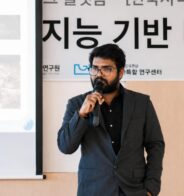
Dr. Elanchezhian Arulmozhi, Ph.D.
Designation
Visiting Faculty
Year of Joining at NU
20th, July 2026
Name and details of Ph.D. Degree awarded Institution
Department of Bio-Systems Engineering, Gyeongsang National University, Jinju, South Korea
Awards/Honours
 Recipient of Sustainovate 2025 Shortlisting from CSIR-NEERI for the project “Climate-Resilient Ammonia Emission Management in Poultry Farms: A Sustainable IoT-Based Solution Using Low-Cost Sensors in India” – recognizing innovative IoT-AI solutions for environmental sustainability.
- Awarded 3 Korean Patents for innovations in livestock automation systems, including automatic feeding devices with bidirectional discharge systems, ML for environmental prediction, and height-adjustable water supply systems.
- Recipient of Research Grants through Gyeongsang National University and Korean Ministry collaborations for AI applications in livestock monitoring, microclimate control models, and animal welfare systems (2018-2024).
- International Research Collaboration Grants supporting joint research with the International Food Policy Research Institute (IFPRI), Economic Research Institute for ASEAN and East Asia (ERIA), Swedish University of Agricultural Sciences (SLU), on Digital Twins in intelligent systems and climate-resilient automation frameworks.
International Recognition
- Emerging Scientist Award (2025) – Awarded by the Darwin Science Club, Tamil Nadu, for contributions to high-quality research in AI and intelligent systems.
- Young Pioneer Researcher Award (2020, 2021) – Conferred twice by Gyeongsang National University for exceptional research productivity and innovation in AI applications.
- Hackathon AI Contest Third Place – For the concept “Farmer Information System Using Big Data Analysis” at Gyeongsang National University.
Academic Distinctions
Dr. Elanchezhian has authored 30+ SCI-indexed journal articles in leading international journals in Artificial Intelligence, Deep Learning, IoT Systems, Digital Twins, and Cyber-Physical Systems, with contributions as both lead author and co-author in collaborative international research.
Best Peer-reviewed Publications (Best 05)
- Arulmozhi, E. , Deb, N. C., Tamrakar, N., Kang, D. Y., Kang, M. Y., Kook, J., Basak, J. K., & Kim, H. T. (2024). From Reality to Virtuality: Revolutionizing Livestock Farming Through Digital Twins. Agriculture, 14(12), 2231. https://doi.org/10.3390/agriculture14122231 (Impact Factor-3.6)
- Arulmozhi, E. , Bhujel, A., Deb, N. C., Tamrakar, N., Kang, M. Y., Kook, J., Kang, D. Y., Seo, E. W., & Kim, H. T. (2024). Development and validation of Low-Cost Indoor Air quality monitoring System for Swine buildings. Sensors, 24(11), 3468. https://doi.org/10.3390/s241113468 (Impact Factor-3.9)
- Arulmozhi, E. , Basak, J. K., Shalaith, T., Park, J., Kim, H. T., & Moon, B. E. (2021). Machine Learning-Based Microclimate Model for Indoor Air Temperature and Relative Humidity Prediction in a Swine Building. Animals, 11(1), 222. https://doi.org/10.3390/ani11010222 (Impact Factor-3.0)
- Bhujel, A., Arulmozhi, E. , Moon, B., & Kim, H. (2021). Deep-Learning-Based Automatic Monitoring of Pigs’ Physico-Temporal Activities at Different Greenhouse Gas Concentrations. Animals, 11(11), 3089. https://doi.org/10.3390/ani11113089 (Impact Factor-3.0) – Contributing deep learning architectures for behavior recognition and locomotion analysis.
- Basak, J. K., Arulmozhi, E. , Moon, B. E., Bhujel, A., & Kim, H. T. (2022). Modelling methane emissions from pig manure using statistical and machine learning methods. Air Quality Atmosphere & Health, 15(4), 575-589. https://doi.org/10.1007/s11869-022-01188-x (Impact Factor-4.0) – Developing hybrid AI models for greenhouse gas emission prediction in agricultural systems.