
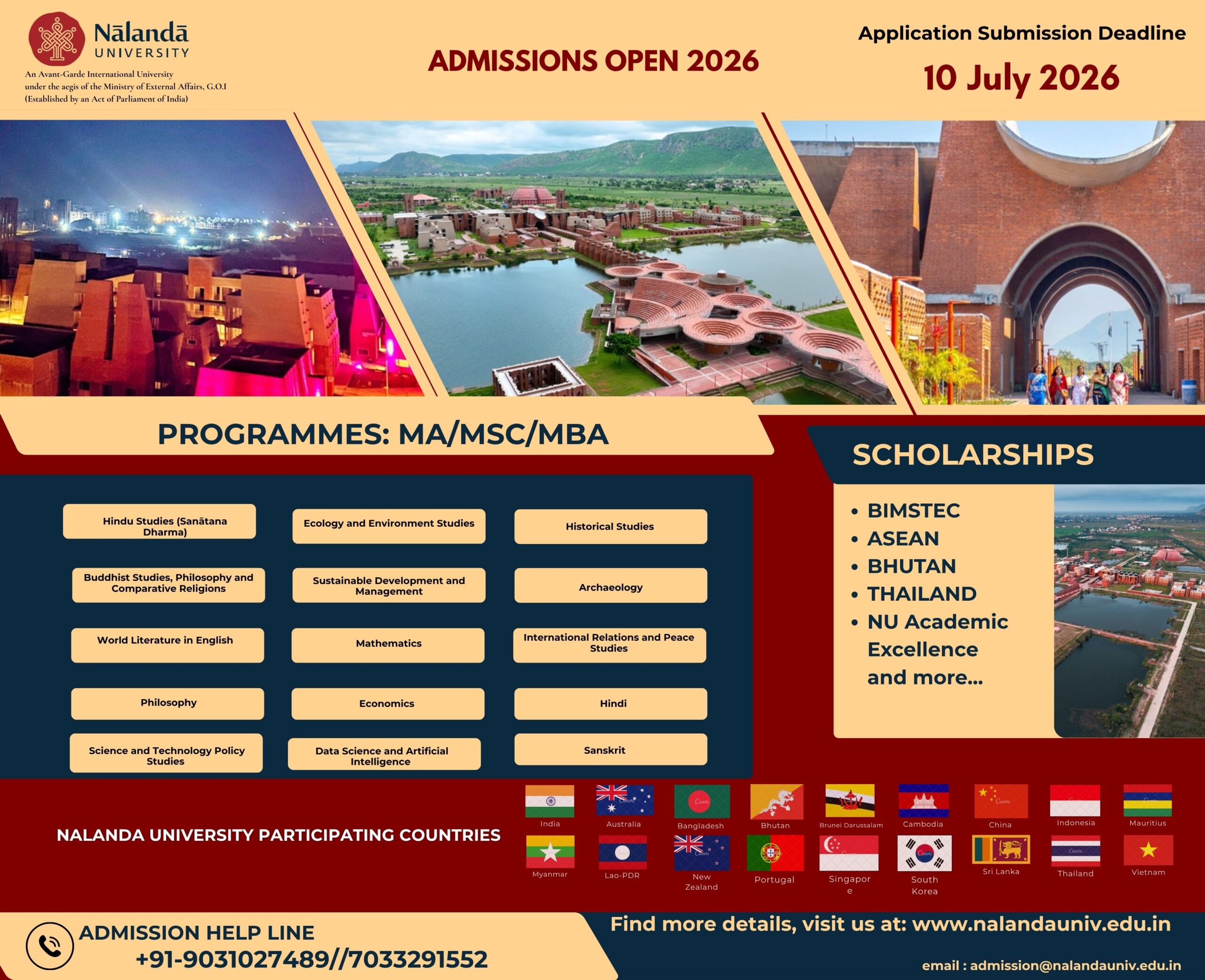
Master’s Programme in Economics (MA Economics)
Nalanda University’s Master’s in Economics is designed as a rigorous, research-oriented programme that combines strong theoretical foundations in micro- and macroeconomics with advanced quantitative training in statistics and econometrics, while situating economic analysis within the historical, institutional, and developmental realities of India, Asia, Africa, and the wider Global South. The programme trains students to think critically about markets, policy, and development, equipping them for careers in research, public policy, banking and finance, international organisations, and doctoral study.
About the Programme/Department of Economics
Economics education stands at a crossroads where new tools, methods, and ways of thinking need to be reinvented periodically, given the challenges being posed by rapidly evolving markets, technologies, and institutions not only on the analytical front but also on the developmental, environmental, and social front. As economies across the Global South gear up to navigate these challenges, the Department of Economics at Nalanda University has been envisaged to prepare a new generation of economists rigorously trained, historically grounded, and policy-ready capable of discovering sustainable and equitable futures for all.
At Nalanda, we believe economics education can play a pivotal role in shaping evidence-based policy and inclusive development, thereby ensuring more resilient, equitable, and sustainable societies through rigorous analysis and sound institutional design. It is with this vision that the Master’s in Economics programme has been developed as a two-year, research-oriented degree combining strong theoretical foundations with advanced quantitative training and applied policy engagement.
The programme aims at training upcoming economists, researchers, and policy analysts who are not only proficient in the core tools of modern economic analysis but are also sensitive to the developmental realities and institutional histories of India, Asia, Africa, Latin America and the wider Global South. Through a comprehensive and interdisciplinary approach to knowledge generation and dissemination, combining classroom teaching, seminar-based research training, and applied fieldwork through mandatory internships, students are trained to think critically, analyse rigorously, and communicate effectively as economists.
Over the course of the programme, we cultivate sustained partnerships with leading research institutions, central banks, regulatory authorities, and international organisations, enabling students to engage directly with applied economic research and public policy alongside their academic training. These collaborations provide valuable opportunities for internships, research projects, policy dialogues, and professional engagement, bridging theoretical learning with real-world economic challenges.
Through these initiatives, the programme seeks to establish itself as a distinctive centre for the study of economics that integrates rigorous quantitative analysis with historical, institutional, and interdisciplinary perspectives. In doing so, it aims to equip graduates with the analytical skills and contextual understanding required to address complex economic issues while advancing Nalanda University’s broader vision as a twenty-first-century hub of interdisciplinary scholarship and global intellectual engagement.
Mission
To establish the Department of Economics at Nalanda University as a distinctive centre for rigorous, research-led training in economics combining strong quantitative foundations with historical and institutional understanding in service of evidence-based policymaking and inclusive development across India and the Global South.
Strategic Priorities
- Build rigorous foundations in microeconomics, macroeconomics, statistics, and econometrics, combined with training in the economic thought
- Develop a research-oriented learning environment that connects classroom theory with applied policy analysis and fieldwork
- Establish and sustain partnerships with central banks, research institutions, regulatory bodies, and international organisations to provide students structured exposure through summer internships
- Offer a wide elective basket spanning trade and finance, development, environment, health, law, digital economy, and behavioural and game-theoretic approaches, enabling students to specialise according to their interests
- Situate the study of markets and policy within the developmental and institutional context of India, Asia, Africa, Latin America and the wider Global South
- Build academic communication, research writing, and presentation skills through dedicated seminar courses across all four semesters, culminating in an independent dissertation
Academic Programme Framework: Credit Structure
The MA Economics programme is an 80 credits program (2026-28 batch onward) which is open to both Indian and International students. At the Department, the student experience will revolve around rigorous training in economic theory and quantitative methods, coupled with a mandatory summer internship, case discussions, data-based exercises, and interaction with visiting faculty from research institutions, central banks, and policy bodies.
Salient Features of MA Economics at Nalanda
- International learning environment
- Rigorous grounding in economic theory, statistics, and econometrics
- Mandatory summer internship
- Fully residential campus located in bucolic and historic setting of Rajgir hills
- Focus on interdisciplinary, policy-oriented approach to learning
- Encourage critical thinking and rigorous quantitative reasoning amongst the students
- Experiential learning based on case discussions, data analysis, and applied research projects in class
- Distinguished faculty from various Universities/Institutes and research bodies from India and abroad
- Experience enrichment through research institutions, policy bodies, and central banks
- Strong institutional interface through internships, mentorships, lectures etc.
- Research and policy focused curriculum
- Seminar courses on academic communication
- Wide range of specialized electives to choose from